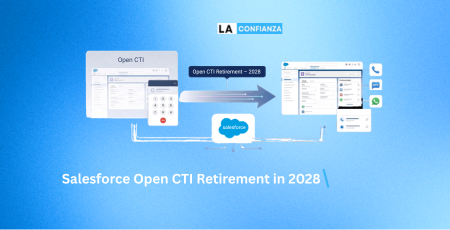
If your contact center runs on Salesforce and connects to a telephony platform like Amazon Connect, Genesys, Five9, NICE, Cisco, or another CTI provider, there's a good chance that connection depends on Open CTI. Salesforce has now confirmed that this framework is being retired, and the clock is officially ticking.
This isn't a rumor or a distant possibility. Salesforce has placed Open CTI in maintenance mode, stopped new implementations for newly created Agentforce Service orgs, and set a hard end-of-life date. For contact center leaders, IT teams, and CX stakeholders, this is the moment to start planning, not after the deadline gets closer.
In this guide, we'll cover exactly what's changing, why Salesforce is making this move, what your migration options are, and how to build a transition plan that doesn't just replace what you have, but actually improves it. We'll also cover how La Confianza Technologies helps businesses across the USA, UK, Singapore, and worldwide plan and execute this migration with minimal disruption.
What Is Salesforce Open CTI, and Why Does This Matter?
Open CTI (Open Computer Telephony Integration) is a JavaScript API that Salesforce introduced back in 2012. It allows third-party telephony systems to embed directly into the Salesforce interface, powering features like:
- Click-to-dial from within Salesforce records
- Screen pops that surface caller information automatically
- Softphone controls (answer, hold, transfer, hang up) inside the Salesforce UI
- Call logging and activity tracking tied to Salesforce objects
For over a decade, Open CTI has been the backbone connecting Salesforce to countless CTI and CCaaS platforms. Many organizations have built deep, highly customized integrations on top of it, including screen pop logic, wrap-up codes, IVR data capture, compliance workflows, and post-call automation. That's exactly why this retirement matters so much: the visible softphone layer is just the surface. The real dependencies often run much deeper into daily agent and supervisor workflows.
The Official Retirement Timeline
Here's what Salesforce has confirmed:
- Current status: Open CTI is in maintenance mode. No new features or enhancements are being added to the framework.
- Immediate restriction: New Agentforce Service orgs can no longer implement or use Open CTI. Existing orgs can continue using it until the retirement date.
- Retirement date: Open CTI officially reaches end-of-life on February 28, 2028.
- After retirement: Existing Open CTI implementations will simply stop functioning.
That gives most organizations roughly 18 to 24 months of real planning and execution time once you factor in vendor evaluation, pilot testing, phased rollout, and validation. On paper, 2028 sounds far away. In migration terms, especially for contact centers with complex, undocumented dependencies, it isn't.
Why Is Salesforce Retiring Open CTI?
Salesforce has been fairly direct about the reasoning: the modern contact center looks nothing like it did in 2012. Customers now expect seamless omnichannel service, agents need real-time context the moment a call connects, and leadership wants visibility across every interaction, not just call logs sitting in a separate system.
Salesforce's stated goal is to move customers toward Salesforce Voice (formerly Service Cloud Voice), which offers native integration with Omni-Channel routing, real-time call transcription, Next Best Action recommendations, and full Agentforce AI capabilities. Legacy CTI, built on external softphones and custom JavaScript, simply has no path to these AI-driven features. Native voice is effectively a prerequisite for Agentforce Voice, Service Rep Assistant, and other autonomous service capabilities Salesforce is investing heavily in.
In short, this retirement isn't just Salesforce cleaning up old code. It's a deliberate push toward a unified platform where voice, digital channels, CRM data, and AI all operate natively together.
What Are Your Migration Options?
Salesforce has laid out a few clear paths forward, and the right one depends on your current architecture, CCaaS vendor relationship, and how central AI is to your roadmap.
1. Salesforce Voice with Partner Telephony
This option lets you keep working with your existing telephony vendor while moving off Open CTI onto the native Salesforce Voice framework. It's often the least disruptive path for organizations with an established CCaaS relationship they want to preserve.
2. Salesforce Voice with Amazon Connect
For organizations already using or considering Amazon Connect, Salesforce Voice offers native support for this pairing. This combination gives you Amazon Connect's flexible, AWS-native contact center capabilities alongside Salesforce's native voice and AI tooling, without relying on the legacy Open CTI bridge.
3. Agentforce Contact Center
Announced in March 2026, Agentforce Contact Center brings native telephony, IVR, and full CCaaS capabilities directly into the Salesforce platform itself. For organizations looking to consolidate vendors and lean fully into Salesforce's AI roadmap, this represents the most complete, all-in-one destination.
Each of these paths comes with different implications for cost, licensing, your existing CCaaS contract, and how quickly you can adopt AI-driven service capabilities. Many organizations will land on a hybrid approach: starting with Salesforce Voice for partner telephony, then evaluating Agentforce Contact Center as a longer-term destination.
Step-by-Step: How to Plan Your Open CTI Migration
Step 1: Audit Where Open CTI Is Actually Used
Some organizations have a clear picture of their Open CTI footprint. Many don't, especially larger enterprises that have inherited multiple Salesforce orgs, custom adapters, and third-party AppExchange packages across different business units. Start with a full audit: which orgs, which packages, which custom Lightning components, and which vendors are involved.
Step 2: Map the Business Processes Running Through It
The softphone is the visible layer, but the real risk sits underneath it. Screen pops, call recording links, case creation logic, wrap-up codes, IVR data capture, compliance workflows, and post-call automation frequently depend on the current integration in ways that were never fully documented. These dependencies tend to surface only when something breaks, so mapping them proactively is critical before you touch anything.
Step 3: Choose Your Destination Architecture
Decide between Salesforce Voice with partner telephony, Salesforce Voice with Amazon Connect, or Agentforce Contact Center, based on your existing vendor relationships, budget, and how much you want to invest in AI-driven service capabilities now versus later.
Step 4: Pilot Before You Scale
Don't attempt a big-bang cutover across your entire contact center. Run a pilot with a smaller team or a single queue, validate call quality, screen pop accuracy, reporting, and compliance workflows, and only then plan the phased rollout to the rest of the organization.
Step 5: Rebuild, Don't Just Replicate
This is the step most organizations underestimate. A like-for-like migration reduces short-term risk, but it also carries forward every limitation your current setup already has. The organizations that get the most value from this transition use it as an opportunity to fix routing gaps, close data fragmentation issues, resolve reporting blind spots, and build real AI readiness at the same time, rather than just recreating the old system inside a new framework.
Step 6: Train Agents and Supervisors Early
Even a technically perfect migration can fail on adoption. Agents who've used the same softphone controls for years need hands-on training on the new interface well before go-live, not a quick walkthrough the week of the cutover.
Step 7: Decommission Legacy Dependencies Fully
Once migration is validated, formally decommission the old Open CTI configuration, call center definition files, and any custom code tied to it. Leaving legacy components in place "just in case" often creates confusion and security exposure down the line.
Common Mistakes to Avoid During Migration
Underestimating hidden dependencies. Open CTI integrations accumulate technical debt over time. Custom Lightning components, AppExchange packages, and reporting logic often depend on the integration in ways that are not documented, and this complexity almost never lives in the licensing or configuration; it lives in discovery, alignment, and testing work that gets rushed.
Waiting too long to start. February 2028 feels distant until you factor in vendor evaluation, procurement cycles, pilot programs, and phased rollout across multiple teams or regions. Many organizations will need 12 to 24 months of real runway.
Treating this as a pure technical swap. Framing this as "replace Open CTI before the deadline" is accurate but incomplete. Organizations that treat it as a broader contact center modernization opportunity get significantly more value out of the same migration effort.
Skipping change management. A new voice interface changes daily habits for every agent and supervisor in your contact center. Without proper training and communication, adoption issues can undo even a technically flawless migration.
Assuming your CCaaS vendor has it handled. Many third-party telephony vendors are still actively updating their own Salesforce integration architecture to remove Open CTI dependencies. Confirm directly with your vendor what their timeline and roadmap actually look like, rather than assuming continuity.
Salesforce Open CTI Retirement: What This Means for Businesses in the USA, UK, Singapore, and Worldwide
This retirement affects any organization running a Salesforce-connected contact center, regardless of where they're headquartered, but the practical considerations do vary by region.
- USA: Many US enterprises run complex, multi-vendor CCaaS environments (Amazon Connect, Genesys, Five9, NICE, Cisco) layered with custom Salesforce configurations built up over a decade or more. These organizations typically need the longest runway for discovery and phased rollout.
- UK: UK-based financial services, insurance, and retail companies often have compliance-driven call recording and data handling requirements that need careful validation during migration, particularly around FCA and GDPR obligations.
- Singapore: As a regional hub for APAC operations, Singapore-based contact centers frequently support multilingual, multi-country routing that adds complexity to migration planning and testing.
At La Confianza Technologies, we support Open CTI migration planning and execution for clients across the USA, UK, Singapore, and worldwide, bringing the same certified Salesforce and AWS expertise regardless of where your team or your customers are located.
How La Confianza Technologies Helps with Open CTI Migration
As a Salesforce and AWS solutions partner, La Confianza Technologies helps organizations navigate this retirement without disruption to daily operations. Our approach includes:
- Full Open CTI Audit: Identifying every org, integration, and dependency currently relying on Open CTI across your business.
- Migration Strategy & Roadmap: Recommending the right destination architecture, whether that's Salesforce Voice with partner telephony, Salesforce Voice with Amazon Connect, or Agentforce Contact Center, based on your specific environment.
- Amazon Connect + Salesforce Expertise: For organizations moving toward Salesforce Voice with Amazon Connect, we bring deep, hands-on experience connecting these two platforms natively.
- Phased Implementation: Structured pilot programs and rollout plans that reduce risk instead of forcing a disruptive big-bang cutover.
- Modernization, Not Just Replication: Using this migration as an opportunity to fix long-standing routing, reporting, and data fragmentation issues, not just recreate them in a new system.
- Post-Migration Support: Ongoing monitoring and optimization after go-live, so your contact center keeps improving well beyond the migration itself.
Final Thoughts
The Salesforce Open CTI retirement on February 28, 2028 is a confirmed, hard deadline, not a distant possibility. Organizations that start planning now, auditing their current dependencies, choosing the right destination architecture, and treating this as a modernization opportunity rather than a forced swap, will come out of this transition with a stronger, more AI-ready contact center. Those who wait will be racing the clock with far less room for a careful, well-tested rollout.
The complexity here rarely lives in licensing or basic configuration. It lives in the discovery, design, testing, and change management work that most organizations significantly underestimate. Starting early is the single biggest advantage you can give yourself.
Ready to Scale? Book a Free Strategy Session With Our Architect
Not sure where your Open CTI dependencies actually live, or which migration path fits your contact center? Get a free, no-obligation 30-minute strategy session directly with our Chief Architect, Dinesh.
Book Your Free Strategy Call Now
Frequently Asked Questions
1. When exactly does Salesforce Open CTI retire? Salesforce has confirmed an official end-of-life date of February 28, 2028. After that date, existing Open CTI implementations will stop functioning entirely.
2. Can I still use Open CTI today? Yes, if you already have an Open CTI implementation, you can continue using it until the retirement date. However, no new Open CTI implementations can be started on newly created Agentforce Service orgs, and no new features or enhancements are being added to the framework.
3. What should I migrate to instead of Open CTI? Salesforce recommends transitioning to Salesforce Voice, which supports partner telephony integrations as well as native Amazon Connect connectivity. Organizations looking for a fully consolidated platform can also evaluate Agentforce Contact Center, which brings native telephony and CCaaS capabilities directly into Salesforce.
4. How long does an Open CTI migration typically take? This depends heavily on the complexity of your existing integration. Simple deployments may take a few months, while organizations with multiple Salesforce orgs, custom Lightning components, and deep compliance workflows should plan for 12 to 24 months, including audit, pilot, and phased rollout.
5. Do we need to hire a Salesforce implementation partner for this migration? It's not strictly required, but strongly recommended for anything beyond a simple deployment. An experienced partner can audit hidden dependencies, recommend the right destination architecture, and manage a phased rollout that avoids the adoption and data issues that commonly derail internal-only migrations.