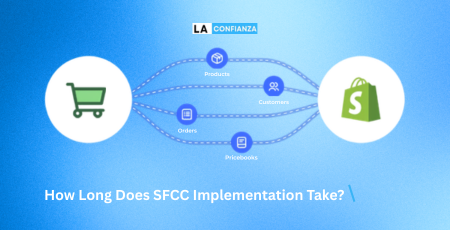
One of the most common questions businesses ask when considering an enterprise ecommerce platform is: how long does SFCC implementation take?
The answer is not a single fixed number. The timeline for implementing Salesforce Commerce Cloud depends on several factors such as business complexity, integration requirements, customization level, and team readiness.
In this article, we break down realistic timelines, implementation phases, and the key factors that influence how long your SFCC project may take.
What Does SFCC Implementation Actually Include?
Before estimating timelines, it’s important to understand what “implementation” really means.
An SFCC implementation is not just setting up an online store. It typically includes:
- Business discovery and requirement gathering
- UX/UI design aligned with brand and customer experience
- Frontend and backend development
- Integration with third-party systems (ERP, CRM, OMS, payment gateways, etc.)
- Product, customer, and order data migration
- Quality assurance and testing
- Deployment and go-live support
- Post-launch stabilization and optimization
Each of these stages contributes to the overall project timeline.
Average SFCC Implementation Timeline
While every project is different, most SFCC implementations fall into one of these categories:
1. Small-Scale Implementation (8–12 weeks)
Best suited for:
- Limited product catalogs
- Minimal integrations
- Standard storefront setup
- Simple business requirements
These projects move quickly due to fewer dependencies and lower customization needs.
2. Medium Complexity Implementation (3–5 months)
Best suited for:
- Mid-sized ecommerce businesses
- Multiple integrations (ERP, payment, shipping)
- Some customization in frontend experience
- Multi-category product structures
This is the most common implementation range.
3. Enterprise-Level Implementation (6–12+ months)
Best suited for:
- Global ecommerce brands
- Multi-region or multi-language setups
- Complex system integrations
- Highly customized storefront experiences
- Large-scale data migration
These projects require extensive planning, coordination, and testing cycles.
Key Factors That Influence SFCC Implementation Time
Several variables can significantly impact how long your project takes:
1. Integration Complexity
The more systems you connect (ERP, CRM, inventory, payment gateways), the longer the implementation takes.
2. Customization Requirements
Highly customized storefronts and workflows require additional development and testing time.
3. Product and Data Migration
Large or unstructured datasets often slow down the migration process.
4. Number of Regions and Stores
Multi-site or multi-country implementations increase design, development, and testing effort.
5. Client Readiness
Delays often occur when requirements, content, or approvals are not finalized on time.
Typical SFCC Implementation Phases
Here’s a breakdown of how time is usually distributed across phases:
1. Discovery & Planning (1–3 weeks)
- Requirement gathering
- Technical architecture planning
- Project roadmap definition
2. Design Phase (2–6 weeks)
- UX/UI design
- Wireframes and prototypes
- Design approvals
3. Development Phase (4–16 weeks)
- Frontend development
- Backend configuration
- Integration development
4. Testing & QA (2–6 weeks)
- Functional testing
- Performance testing
- Bug fixing and optimization
5. Deployment & Go-Live (1–2 weeks)
- Production deployment
- Final validations
- Go-live support
Common Reasons SFCC Projects Get Delayed
Even well-planned projects can face delays due to:
- Changing requirements during development
- Delayed content or product data from stakeholders
- Integration issues with legacy systems
- Lack of internal decision-making speed
- Insufficient testing cycles
In most cases, delays are not caused by development alone, but by coordination across teams.
How to Speed Up SFCC Implementation
While complexity cannot always be avoided, timelines can be optimized by:
- Clearly defining requirements early
- Finalizing integrations before development starts
- Preparing product and content data in advance
- Following an agile delivery approach
- Working with an experienced implementation partner
A well-structured approach can significantly reduce delivery risks and rework.
Final Thoughts
There is no one-size-fits-all answer to how long SFCC implementation takes. However, most projects fall between 2 months and 12+ months, depending on complexity and scope.
A successful implementation is not just about speed, it’s about building a scalable, stable, and high-performing ecommerce foundation.
If you’re planning an SFCC implementation, having a clear roadmap and experienced technical guidance can help ensure realistic timelines and a smoother launch.