Start a Project
Oops! Something went wrong while submitting the form.
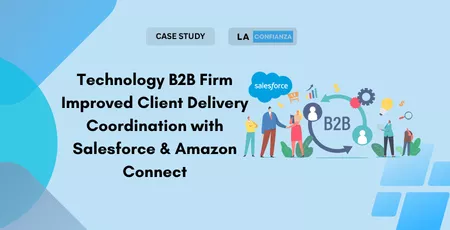
For technology services companies, client communication is not just a support function; it is deeply tied to delivery, account growth, and long-term relationships. From project updates and issue resolution to ongoing engagement and renewals, every interaction contributes to how clients perceive reliability and execution. We partnered with a leading technology services company to strengthen how their global teams manage client communication. As their delivery footprint expanded, they needed a more structured system to support real-time coordination across teams and geographies. The goal was to move from fragmented communication to a connected client operations layer that supports both delivery efficiency and client experience.
As the organization scaled, communication became a bottleneck in execution rather than an enabler.
Key challenges were rooted in how client interactions were managed across delivery teams:
This created friction in day-to-day operations.
For example:
From a business standpoint, this affected:
We implemented a unified communication and interaction management layer using Salesforce and Amazon Connect to support their delivery-driven organizations.
Instead of treating Salesforce as just a CRM, we positioned it as a central system for managing all client interactions.
This created alignment across teams that were previously working in silos.
We designed routing logic based on how the organization operates:
This ensured that client requests are handled by the right teams without delays.
We introduced structured workflows to manage escalations and callbacks.
This reduced the risk of missed communication during critical delivery cycles.
We enabled full visibility into client communication across the organization.
This improved both transparency and accountability.
With a unified system in place:
This was particularly valuable for managing global delivery models.
The transformation had a direct impact on how the organization managed client relationships and delivery operations.
One of the most important shifts was the creation of a connected client operations layer. Communication was no longer isolated but became an integrated part of delivery workflows.
With Salesforce acting as the central system of engagement, teams across delivery, support, and account management operated with shared visibility. This reduced internal dependencies and improved coordination.
The introduction of structured routing and follow-up workflows ensured that client queries and escalations were handled consistently, without delays or gaps.
From an operational perspective:
From a client experience perspective:
Before:
After:
The organization moved from managing communication as a support function to using it as a strategic layer that supports delivery, efficiency, and client satisfaction.
If your delivery teams rely on scattered tools and manual follow-ups, communication gaps can directly impact execution and client experience.
We help technology services teams design structured systems that connect communication with delivery workflows improving visibility, coordination, and responsiveness.
Let’s identify where your client communication is breaking down and how to fix it.


Salesforce
Let La Confianza Tech be your trusted partner in building a smarter, more connected business.



.png)