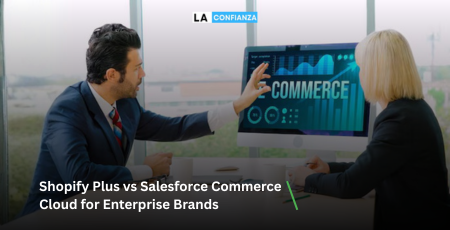
Choosing the right ecommerce platform is one of the most important technology decisions for enterprise brands. As digital commerce continues to evolve, businesses require platforms that can support scalability, customer experience personalization, omnichannel operations, and rapid innovation.
Two of the leading enterprise ecommerce platforms in the market today are Shopify Plus and Salesforce Commerce Cloud (SFCC).
While both platforms power high-growth and global brands, they are designed with fundamentally different approaches to ecommerce operations.
Shopify Plus is known for its speed, simplicity, and ease of use, while Salesforce Commerce Cloud is recognized for deep enterprise customization, advanced integrations, and unified customer experiences.
For enterprise businesses evaluating ecommerce replatforming initiatives, understanding the differences between Shopify Plus and Salesforce Commerce Cloud is critical.
In this guide, we’ll compare Shopify Plus and Salesforce Commerce Cloud across architecture, scalability, customization, integrations, pricing, enterprise capabilities, and overall business fit.
What Is Shopify Plus?
Shopify Plus is Shopify’s enterprise ecommerce solution designed for high-growth and high-volume brands. It provides a cloud-based SaaS platform focused on speed, operational simplicity, and rapid deployment.
Shopify Plus is particularly popular among:
- D2C brands
- Fast-scaling ecommerce companies
- Lifestyle and fashion brands
- Businesses prioritizing agility and fast go-to-market
Over the past few years, Shopify Plus has significantly expanded its enterprise capabilities through:
- Headless commerce support
- Commerce Components
- B2B functionality
- AI-powered tools
- Advanced automation features
What Is Salesforce Commerce Cloud?
Salesforce Commerce Cloud (SFCC) is an enterprise-grade ecommerce platform built for large-scale and complex commerce operations.
SFCC is part of the broader Salesforce ecosystem and offers deep integration with:
- Salesforce CRM
- Marketing Cloud
- Service Cloud
- Data Cloud
- AI-powered personalization tools
The platform is widely used by enterprises managing:
- Multi-brand operations
- Global storefronts
- Complex B2B workflows
- Omnichannel commerce ecosystems
Shopify Plus vs Salesforce Commerce Cloud: Key Differences
Platform Architecture
Shopify Plus
Shopify Plus follows a SaaS-first architecture designed for operational simplicity. The platform handles:
- Hosting
- Security
- Infrastructure management
- Updates
- Performance optimization
This allows businesses to focus more on growth and customer experience rather than technical maintenance.
Salesforce Commerce Cloud
SFCC also offers cloud-based infrastructure but provides significantly deeper enterprise customization and operational flexibility.
The platform is designed for organizations requiring:
- Complex business logic
- Enterprise integrations
- Advanced workflows
- Multi-market commerce orchestration
Ease of Use and Time-to-Market
One of Shopify Plus’s strongest advantages is speed.
Businesses can:
- Launch storefronts faster
- Deploy campaigns quickly
- Manage operations with smaller technical teams
Shopify’s admin interface is often considered more user-friendly compared to traditional enterprise commerce platforms.
In contrast, Salesforce Commerce Cloud implementations are typically more complex and require experienced development teams or implementation partners.
However, that complexity enables greater enterprise flexibility and customization.
Customization and Flexibility
Shopify Plus
Shopify Plus offers extensive customization through:
- APIs
- Apps
- Headless commerce frameworks
- Shopify Functions
- Commerce Components
However, because Shopify is a SaaS platform, certain backend customizations remain limited compared to SFCC.
Salesforce Commerce Cloud
SFCC is designed for enterprise-level customization.
It supports:
- Complex pricing structures
- Advanced workflows
- Multi-site management
- Deep personalization
- Enterprise-grade business logic
This makes SFCC more suitable for businesses with highly customized commerce operations.
Scalability and Enterprise Readiness
Both platforms support enterprise-scale commerce, but their strengths differ.
Shopify Plus Scalability
Shopify Plus excels in:
- Rapid scaling
- High-traffic handling
- Operational simplicity
- Global D2C expansion
It is often favored by fast-moving brands prioritizing agility and speed.
SFCC Enterprise Capabilities
Salesforce Commerce Cloud is optimized for:
- Enterprise commerce ecosystems
- Omnichannel orchestration
- Global operations
- Complex B2B and B2C environments
- Unified customer experiences
For businesses already invested in Salesforce products, SFCC provides significant ecosystem advantages.
Integrations and Ecosystem
Shopify Plus Ecosystem
Shopify Plus has a massive app marketplace and partner ecosystem that enables fast integration deployment.
Popular integrations include:
- ERP systems
- Marketing tools
- Payment gateways
- Inventory management platforms
- Analytics solutions
Its ecosystem flexibility is one of its biggest strengths.
Salesforce Commerce Cloud Ecosystem
SFCC’s key advantage lies in native Salesforce ecosystem integration.
Businesses can create unified commerce experiences across:
- Sales
- Marketing
- Customer service
- Commerce operations
This centralized customer data model is especially valuable for enterprises prioritizing personalization and customer lifecycle management.
Pricing and Total Cost of Ownership (TCO)
Pricing is one of the biggest differences between the two platforms.
Shopify Plus Pricing
Shopify Plus generally offers:
- Lower implementation costs
- Faster deployment timelines
- Predictable subscription pricing
- Reduced infrastructure management costs
This often results in lower overall TCO for many businesses.
Salesforce Commerce Cloud Pricing
SFCC pricing is typically:
- Enterprise quote-based
- Revenue-dependent
- More complex
Implementation and integration costs can also be significantly higher due to enterprise customization requirements.
However, for organizations requiring advanced enterprise orchestration, the investment may align with long-term operational goals.
Shopify Plus vs SFCC for B2B Commerce
B2B commerce requirements can heavily influence platform selection.
Shopify Plus B2B
Shopify Plus has rapidly expanded its B2B capabilities, including:
- Company accounts
- Price lists
- Wholesale portals
- B2B checkout experiences
However, some highly complex procurement workflows may still require custom solutions.
Salesforce Commerce Cloud for B2B
SFCC is often better suited for:
- Complex pricing models
- Enterprise procurement workflows
- Multi-level approvals
- Advanced account structures
- Large-scale B2B operations
Which Platform Is Better for Enterprise Brands?
The answer depends entirely on business priorities.
Choose Shopify Plus If Your Business Prioritizes:
- Faster time-to-market
- Operational simplicity
- Lower total cost of ownership
- Agile ecommerce execution
- D2C growth
- Smaller internal technical teams
Choose Salesforce Commerce Cloud If Your Business Requires:
- Deep enterprise customization
- Unified Salesforce ecosystem integration
- Advanced omnichannel commerce
- Complex B2B workflows
- Multi-brand global operations
- Enterprise-grade personalization
Migration Considerations
For businesses considering migration to either platform, careful planning is essential.
Key migration considerations include:
- Data migration
- SEO preservation
- Integration mapping
- Customer experience continuity
- Checkout optimization
- Platform scalability
- Internal operational readiness
A successful replatforming strategy should align technology decisions with long-term business growth objectives.
Why Work with an Ecommerce Implementation Partner?
Choosing between Shopify Plus and Salesforce Commerce Cloud involves more than feature comparisons.
Businesses must evaluate:
- Operational complexity
- Internal technical capabilities
- Long-term scalability
- Customer experience goals
- Integration requirements
- Total cost of ownership
An experienced ecommerce implementation partner can help organizations:
- Assess platform fit
- Define migration strategies
- Reduce implementation risks
- Accelerate deployment
- Optimize long-term platform performance
Conclusion
Both Shopify Plus and Salesforce Commerce Cloud are powerful enterprise ecommerce platforms, but they serve different business needs.
Shopify Plus focuses on agility, operational simplicity, and rapid commerce execution, making it an attractive option for fast-growing and digitally native brands.
Salesforce Commerce Cloud, on the other hand, is designed for enterprises requiring deep customization, advanced integrations, and unified customer experiences across complex commerce ecosystems.
Rather than asking which platform is universally better, enterprise businesses should focus on which platform best aligns with their operational model, growth strategy, and customer experience goals.
With the right implementation strategy and technology partner, both platforms can support scalable, high-performing digital commerce experiences.
Evaluating Shopify Plus or Salesforce Commerce Cloud?
Our ecommerce experts help enterprise brands assess platform fit, plan replatforming strategies, and implement scalable commerce solutions tailored to long-term business growth.
Contact our team to discuss your ecommerce transformation goals.
FAQs
1. Is Shopify Plus suitable for enterprise ecommerce?
Yes, Shopify Plus supports enterprise brands with scalable infrastructure, headless commerce capabilities, automation tools, and global commerce support.
2. Why do enterprises choose Salesforce Commerce Cloud?
Enterprises often choose SFCC for its deep customization, omnichannel capabilities, AI-driven personalization, and native Salesforce ecosystem integration.
3. Which platform has a lower total cost of ownership?
Shopify Plus generally offers lower implementation and operational costs compared to Salesforce Commerce Cloud.
4. Is Salesforce Commerce Cloud better for B2B commerce?
For highly complex B2B workflows and enterprise procurement requirements, SFCC is often considered more suitable.
5. Can businesses migrate from Salesforce Commerce Cloud to Shopify Plus?
Yes, many businesses migrate between ecommerce platforms based on operational goals, scalability needs, and digital transformation strategies.