
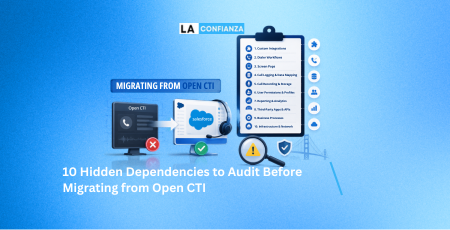
Many organizations are modernizing their customer service operations by moving from Open CTI to advanced cloud contact center solutions such as Salesforce Voice or Amazon Connect. These modern platforms offer AI-powered capabilities, real-time call transcription, intelligent routing, omnichannel support, and deeper integration with Salesforce Service Cloud.
However, migrating from Open CTI is not simply a matter of replacing one telephony solution with another.
Over the years, many Salesforce environments evolve with custom integrations, automation, workflows, APIs, reports, and user-specific configurations that depend on the existing CTI implementation. These dependencies often go unnoticed until the migration process begins, leading to unexpected delays, broken functionality, and increased project costs.
A successful Open CTI migration starts with a comprehensive assessment of your Salesforce environment. By identifying hidden dependencies early, organizations can reduce risk, maintain business continuity, and ensure a smooth transition to a modern contact center platform.
In this guide, we'll explore ten commonly overlooked dependencies that every organization should audit before migrating from Open CTI.
Why Open CTI Migrations Require Careful Planning
Unlike standalone telephony applications, Open CTI is often deeply integrated into Salesforce. Over time, organizations customize their CRM to support unique customer service processes, sales workflows, and business requirements.
These customizations may include:
- Custom Lightning components
- Visualforce pages
- Apex classes
- Process Builder automations
- Flow automations
- Third-party APIs
- Custom call logging
- Reports and dashboards
- Permission sets
- Role hierarchies
Replacing the telephony platform without evaluating these dependencies can result in missing functionality, inconsistent customer experiences, and operational disruptions.
A structured audit helps organizations understand how voice capabilities interact with the rest of the Salesforce ecosystem before any migration begins.
The Risks of Overlooking Hidden Dependencies
Organizations that skip a dependency assessment often encounter challenges such as:
- Broken call workflows
- Missing customer records
- Failed API integrations
- Incorrect call logging
- Incomplete reporting
- Permission issues
- User adoption challenges
- Longer implementation timelines
- Increased migration costs
- Service disruptions
A proactive audit minimizes these risks while improving project planning and implementation accuracy.
Hidden Dependency #1: Existing CTI Customizations
One of the most overlooked aspects of an Open CTI migration is the level of customization built around the existing telephony solution.
Many organizations have customized their CTI implementation to support unique business processes, including:
- Custom softphone layouts
- Screen pop logic
- Call routing rules
- Custom buttons
- Agent workflows
- Click-to-call enhancements
These customizations may not automatically transfer to Salesforce Voice or another contact center platform.
Before migrating, document every customization and determine:
- Why it exists
- Whether it is still required
- How it will be recreated in the new environment
- Whether newer platform capabilities can replace it
In many cases, organizations discover they can simplify processes instead of rebuilding legacy customizations.
Hidden Dependency #2: Third-Party Telephony Integrations
Many Open CTI implementations rely on external telephony providers that connect Salesforce with PBX systems, SIP providers, or cloud contact center platforms.
Examples include integrations with:
- Amazon Connect
- Cisco
- Genesys
- Five9
- RingCentral
- Avaya
- NICE CXone
- Twilio
These integrations may include custom APIs, middleware, authentication methods, or vendor-specific configurations.
During your audit, evaluate:
- Existing telephony architecture
- Connected applications
- Authentication mechanisms
- API usage
- Middleware dependencies
- Vendor-specific customizations
Understanding these integrations early helps avoid compatibility issues during migration.
Hidden Dependency #3: Apex Classes, Triggers, and Custom Code
Many Salesforce implementations include Apex code that interacts with CTI events.
Examples include:
- Automatic call record creation
- Agent status updates
- Customer record synchronization
- Case creation after calls
- Custom notifications
- Call disposition processing
Review all Apex classes and triggers to identify references to:
- CTI APIs
- Telephony events
- Call objects
- Voice workflows
- External web services
Custom code may require refactoring to support Salesforce Voice or another telephony platform.
Ignoring custom Apex dependencies can result in broken automation after migration.
Hidden Dependency #4: Visualforce Pages and Lightning Components
Although many organizations have migrated to Lightning Experience, legacy Visualforce pages are still common in Open CTI implementations.
You may find custom components used for:
- Embedded softphones
- Agent dashboards
- Customer lookup
- Call controls
- Internal support tools
Similarly, Lightning Web Components (LWCs) or Aura Components may interact with Open CTI APIs.
During the assessment, identify:
- Embedded CTI widgets
- Custom Lightning components
- Visualforce integrations
- JavaScript dependencies
- API references
Modern platforms such as Salesforce Voice may offer native alternatives that eliminate the need for some legacy components.
Hidden Dependency #5: Call Logging and Activity History
Call history is essential for customer service reporting, compliance, and sales visibility.
Organizations often customize call logging to capture:
- Call duration
- Agent details
- Customer information
- Call recordings
- Disposition codes
- Follow-up tasks
- Notes
- Call outcomes
Before migration, determine:
- How call data is currently stored
- Which objects contain historical records
- Whether custom fields are used
- How reports depend on call history
- Whether historical data needs to be migrated
Preserving historical call information ensures reporting continuity and supports future customer interactions.
Why These First Five Dependencies Matter
The first five dependencies represent the technical foundation of most Open CTI implementations. Customizations, integrations, custom code, user interfaces, and historical call data are often deeply connected to business operations.
Identifying and documenting these dependencies before migration helps organizations:
- Reduce implementation risk
- Improve project planning
- Preserve business functionality
- Avoid unnecessary redevelopment
- Ensure a smoother transition to Salesforce Voice or another cloud contact center solution
A thorough technical assessment at this stage lays the groundwork for a successful migration and minimizes unexpected issues later in the project.
Hidden Dependency #6: Workflow Rules, Process Builder, and Flow Automation
Many organizations have built business processes around Open CTI using Salesforce automation tools. These workflows often trigger actions based on call events, case updates, or customer interactions.
Examples include:
- Automatically creating follow-up tasks after a completed call
- Updating case statuses based on call outcomes
- Sending email notifications to customers
- Assigning cases to specific support teams
- Triggering approval workflows
- Escalating high-priority customer issues
Before migrating, review all:
- Salesforce Flows
- Workflow Rules
- Process Builder automations
- Approval Processes
- Scheduled automations
Determine whether these automations depend on Open CTI objects, fields, or events. Updating them before migration helps prevent broken workflows and ensures a seamless transition.
Hidden Dependency #7: Reports and Dashboards
Salesforce reports and dashboards provide valuable insights into contact center performance. However, many organizations build these reports using data generated by Open CTI.
Common reporting metrics include:
- Call volume
- Average handling time
- Missed calls
- Agent activity
- Customer response times
- First-call resolution
- Call outcomes
If the underlying data structure changes after migration, existing reports may no longer function correctly.
During your audit:
- Identify reports using CTI-related fields
- Review dashboard components
- Document custom report types
- Verify historical reporting requirements
- Plan how reporting will work in the new solution
This ensures business leaders continue to receive accurate operational insights after migration.
Hidden Dependency #8: User Profiles, Permission Sets, and Security
Security settings are often overlooked during telephony migrations.
Users may have permissions specifically configured for:
- CTI softphone access
- Custom objects
- Apex classes
- Visualforce pages
- Lightning components
- API integrations
- Call recording access
Review:
- Profiles
- Permission Sets
- Permission Set Groups
- Sharing Rules
- Role Hierarchies
- Object permissions
- Field-level security
A security audit helps ensure agents, supervisors, and administrators have appropriate access once the new telephony platform is deployed.
Hidden Dependency #9: API Integrations and Middleware
Most enterprise Salesforce environments connect with multiple external applications.
Examples include:
- ERP systems
- CRM platforms
- Workforce management solutions
- Customer support tools
- Analytics platforms
- Payment gateways
- Identity providers
Many of these integrations exchange call-related information through APIs or middleware solutions such as MuleSoft.
Before migration:
- Document every API connection
- Identify data flows
- Review authentication methods
- Verify middleware configurations
- Test external dependencies
Ignoring API dependencies can interrupt critical business processes and impact customer service operations.
Hidden Dependency #10: User Training and Change Management
Technology is only one part of a successful migration. Even the most advanced contact center solution will struggle if users are not prepared for the transition.
Moving from Open CTI to Salesforce Voice introduces new features such as:
- Unified agent workspace
- AI-powered recommendations
- Real-time transcription
- Enhanced reporting
- Omnichannel engagement
- Updated call handling workflows
Without proper training, organizations may experience:
- Lower productivity
- Reduced adoption
- Increased support requests
- User frustration
- Delayed return on investment
A structured change management plan should include:
- Role-based training
- Documentation
- Hands-on workshops
- Pilot testing
- Feedback sessions
- Ongoing support after deployment
Preparing users early increases confidence and accelerates adoption of the new platform.
Open CTI Migration Best Practices
A successful migration requires more than replacing telephony software. Following best practices helps reduce risk and ensures business continuity.
Conduct a Comprehensive Discovery Assessment
Review your Salesforce environment, integrations, customizations, automation, reports, and user requirements before planning the migration.
Involve Business Stakeholders Early
Engage customer service managers, Salesforce administrators, IT teams, and business users to understand current processes and future requirements.
Clean Up Legacy Customizations
Not every customization needs to be rebuilt. Remove outdated workflows and simplify processes where possible to reduce complexity.
Test Thoroughly Before Go-Live
Validate integrations, automation, reporting, security, and user workflows in a sandbox environment before deploying changes to production.
Roll Out in Phases
For large organizations, consider a phased implementation. Migrating teams gradually reduces operational risk and allows time to address issues before a full rollout.
Monitor Performance After Migration
Track key performance indicators such as call handling time, first-call resolution, user adoption, and customer satisfaction to measure the success of the migration.
Why Choose La Confianza Technologies?
Migrating from Open CTI requires careful planning, technical expertise, and a deep understanding of Salesforce architecture. At La Confianza Technologies, we help businesses modernize their contact centers with secure, scalable, and future-ready Salesforce solutions.
Our team specializes in assessing existing Salesforce environments, identifying hidden dependencies, and delivering smooth migration strategies that minimize disruption and maximize business value.
Our Expertise Includes
- Salesforce Consulting Services
- Salesforce Voice Implementation
- Open CTI Migration Assessment
- Amazon Connect Integration
- Salesforce Service Cloud Consulting
- Salesforce Integration Services
- CRM Modernization
- Contact Center Transformation
- Managed Salesforce Services
Why Businesses Choose La Confianza Technologies
- Certified Salesforce consultants and developers
- Experience with enterprise contact center migrations
- Expertise in Salesforce Voice and Amazon Connect
- End-to-end migration planning and implementation
- Secure and scalable integration architecture
- Transparent project delivery
- Ongoing optimization and support
Whether you're replacing an existing Open CTI solution or planning a complete contact center transformation, our experts can help you migrate with confidence.
Conclusion
Migrating from Open CTI is more than a technology upgrade, it's an opportunity to modernize your customer service operations and prepare your business for future growth. However, overlooking hidden dependencies can lead to unexpected challenges, project delays, and disruptions to daily operations.
By auditing customizations, integrations, automation, reports, security settings, APIs, and user readiness before migration, organizations can significantly reduce risk and create a smoother transition to Salesforce Voice or another cloud contact center platform.
A structured migration strategy, combined with the guidance of an experienced Salesforce consulting partner, ensures that your new solution not only replaces existing functionality but also delivers improved productivity, enhanced customer experiences, and long-term scalability.
Planning Your Open CTI Migration?
A successful migration starts with understanding what's behind your current implementation. Hidden dependencies can impact timelines, increase costs, and create unnecessary risks if they're not identified early.
At La Confianza Technologies, we help organizations assess their Salesforce environment, identify migration risks, and implement modern contact center solutions with confidence. Whether you're moving to Salesforce Voice, integrating Amazon Connect, or modernizing your customer service operations, our experts are here to guide you every step of the way.
Book a Free 30-Minute Migration Consultation
Discuss your current Open CTI setup, migration goals, and technical challenges with our Salesforce specialists.
Let's build a secure, scalable, and future-ready contact center together.
Frequently Asked Questions (FAQs)
1. Why is an Open CTI dependency audit important before migration?
A dependency audit identifies customizations, integrations, automation, and other components that rely on Open CTI. Addressing these dependencies before migration helps prevent functionality issues and reduces implementation risks.
2. What are the most common hidden dependencies in Open CTI implementations?
Common dependencies include Apex classes, Lightning components, Visualforce pages, workflow automation, API integrations, reports, dashboards, permission sets, and third-party telephony configurations.
3. Can I migrate directly from Open CTI to Salesforce Voice?
Yes, but the migration should begin with a thorough assessment of your Salesforce environment to ensure all business processes and integrations are accounted for before implementation.
4. How long does an Open CTI migration typically take?
The timeline depends on the complexity of your Salesforce environment, customizations, integrations, and business requirements. Enterprise migrations generally require detailed planning, testing, and phased deployment.
5. Will historical call records be preserved during migration?
Yes, historical call data can often be retained, provided it is identified during the planning phase and incorporated into the migration strategy.
.png)
.png)
